
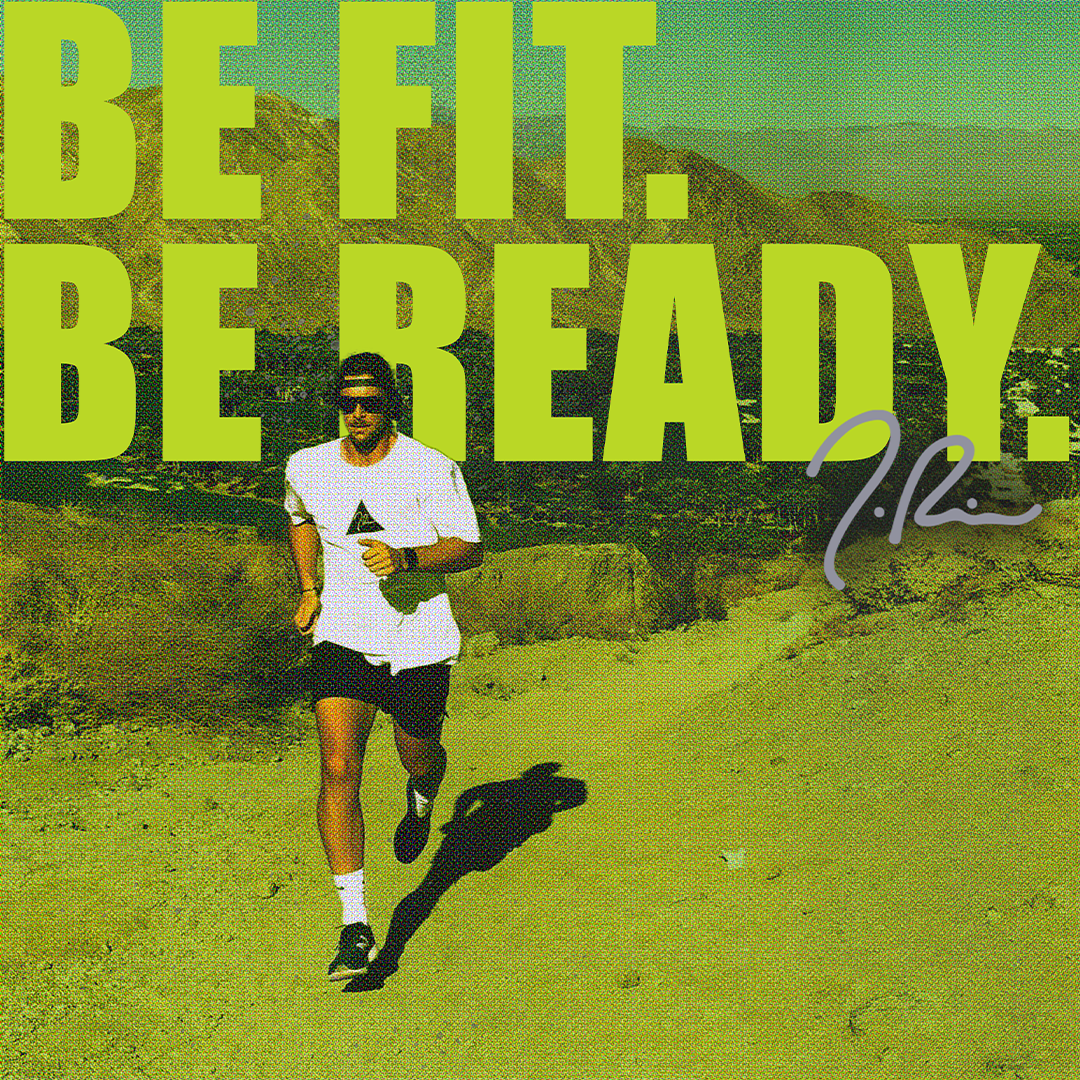
Taylor Rice explains what Be Fit, Be Ready means: real-world fitness, movement efficiency, strength, coordination and sustainable training.
Mutil-Digital Capita
1:1 Training
May 10, 2025
By Taylor J. Rice | T Rice Fitness
The truth is that most people think being fit means looking fit. Visible muscle, step counts, the gym routine, the sweat—those are the things the fitness world loves to measure. But here's my question: when life asks more from you, are you ready?
Can you move well under pressure? Can you change direction, carry something heavy, keep your balance, or handle an unexpected physical challenge? Can you build strength without forgetting about recovery? That's where my philosophy begins.
Be Fit, Be Ready isn't just a slogan. It's a way of thinking about real-world fitness, movement efficiency, and physical readiness. The point isn't to fear what life might throw at you. It's to develop the capacity to respond.
We've been sold an incomplete story about fitness. A strong physique can reflect hard work. Running five miles can be a meaningful achievement. High-intensity training has real benefits when it is programmed appropriately. But none of those things, by itself, tells me everything about how someone moves.
That's what I challenge in my approach. Being strong in one setting doesn't automatically mean you've practiced balance, deceleration, coordination, or the movements you need outside the gym.
To Be Fit is to develop usable capacity: strength, conditioning, mobility, and control appropriate for your life.
To Be Ready is to practice those abilities consistently, adapt them to your circumstances, and take recovery seriously enough that you can show up again.
I want people to think beyond aesthetics. Not because aesthetics are wrong, but because the body is more than what you see in the mirror.
I created the T Rice Fitness Method because I was tired of the idea that everybody needs the same workout and the same motivation speech. People have different demands, abilities, training histories, and goals. A good strategy should start by understanding those differences.
I look at movement as an interconnected system. Your nervous system coordinates muscle activity. Your joints move under load. Your tissues adapt to training over time. Sleep, nutrition, and recovery help determine how sustainable the process is.
No single system explains everything. Your nervous system is not a magic switch that determines all healing, hormones, or fat loss. But it plays an important role in motor control, learning, and how you respond to activity. That's why it belongs in the conversation.
If you want to understand that part of my philosophy, start with The Nervous System Is the Operating System.
Movement economy is one of the missing pieces in how I see fitness. I'm talking about how you organize effort, control movement, and use the capabilities you've developed.
It doesn't mean that every movement has one perfect form. It means learning how to move with enough control for the task in front of you and enough options to adapt when the task changes.
Think about walking, turning, stopping, picking something up, reaching overhead, or getting up from the floor. These are ordinary actions, but they still depend on coordination and physical capacity.
People don't always move inefficiently because they're lazy. Sometimes they've never practiced the skill, sometimes their training is too narrow, and sometimes pain, fatigue, or other factors affect what they can do.
My job is not to label that person as broken. It's to find a sensible way forward, build skills progressively, and help them become more confident with movement.
For a closer look at daily movement, read Movement Is Your Metabolism.
Strength training helps develop physical capacity. Depending on your goals, this may include lifting, carrying, pushing, pulling, squatting, and other movements matched to your current ability. Progression matters more than copying the hardest workout you see online.
Mobility is not a contest to reach the largest possible range of motion. I want people to develop movement options they can control and use when they need them. That involves practice, appropriate loading, and attention to individual limitations.
Staying on your feet, adjusting to a changing environment, and moving with confidence all involve skills we can practice. Balance training is particularly important as we age, but coordination matters for athletes and everyday movement too.
Fitness isn't limited to an hour in the gym. Walking, cycling, sports, and other activities help build endurance and support health. Current U.S. physical activity guidance encourages adults to combine aerobic activity with muscle-strengthening activity, while older adults should also include balance-focused work.
Training creates demands. Recovery is part of adapting to those demands. Sleep, sensible progression, and an approach you can sustain are not signs of weakness—they are part of the strategy. I don't want you to treat every hard day as proof that you need to go even harder tomorrow.
None of these elements requires a secret biological formula. They require understanding, practice, and consistency.
Here's the distinction I want you to remember. You can be highly trained in one area and still have room to improve somewhere else. Someone with excellent endurance might need to work on strength. Someone very strong might benefit from more movement variety or balance practice. An athlete preparing for competition has different requirements than a parent trying to stay active with their family.
So ask yourself: Ready for what?
Ready for your sport? Ready for long workdays? Ready to travel, hike, lift, play, or keep up with your children? The answer shapes the plan.
That's why I don't teach hustle culture as the entire solution. We need direction. We need a system. We need to understand how the pieces fit.
Don't overcomplicate the starting point. Here are five questions I would ask before designing a more demanding routine:
My objective is not to give everyone the exact same workout. It is to create a strategy with the person in mind.
If you'd like coaching built around your goals, explore 1:1 Training with T Rice Fitness.
It's an approach to physical training that considers the demands of everyday life or sport. Depending on your goals, it can include strength, conditioning, balance, mobility, and movement-skill practice rather than focusing on one fitness metric.
They can overlap significantly. Traditional strength training is a useful foundation for many real-world tasks. What matters is selecting exercises and activities that suit the person's goals and progressively developing the abilities they need.
No single posture guarantees injury prevention. Strength, activity exposure, technique for a specific task, health history, and other factors affect injury risk. Posture awareness can help someone learn about movement, but it shouldn't become a promise of being injury-proof. Read Posture Is the Gateway for more.
People can benefit from appropriate physical activity across the lifespan. The best training approach depends on current abilities, health conditions, and personal goals. Progress can be gradual and doesn't have to look like an athlete's schedule.
I want you prepared for more than a gym photo. Prepared to move, to adapt, to recover, and to keep building when life gets complicated.
“Be Fit, Be Ready” isn't just a slogan. It's a biological imperative. That's how strongly I feel about learning to use the body you've been given. Not because everybody needs to be a professional athlete, but because meaningful physical capacity can help you live the life you want.
This is my invitation to move with intention, train with purpose, and stop outsourcing all of your decisions about your body to noise and hype.
The Freshington Formula is a phrase I use for this commitment to being prepared day after day. We'll continue exploring that philosophy through the movement, recovery, and training articles here at T Rice Fitness.
Until then: Stand tall. Stay sharp. Stay Freshington.
— Taylor J. Rice
Explore Taylor Rice’s Tissue Hydration program for another perspective on movement and physical awareness.



Access your optimal performance. Live pain free.
© 2025 T. RICE FITNESS. All Rights Reserved.
Powered By
Webflow
Built By
Rick Mummery